
tDataPlusInput and tDataPlusOutput: The new native Qlik Talend components for the data+ Suite
Updated: Sep 24
data+ is evolving – towards a central platform for operational data processes, planning and bidirectional integration in the modern analytics stack.
Companies today expect more from their BI landscape than mere visualization and reporting. They want data not only to be analyzed, but also actively used, enriched, and integrated back into operational processes.
This is precisely where leitart's data+ Suite comes in: It extends Qlik Sense with powerful input, workflow and writeback functionalities and connects business units directly with the underlying data processes.
But true enterprise analytics doesn't end at the front end. Seamless integration into existing data architectures, ETL/ELT pipelines, and core data engineering processes is crucial. That's why we're now consistently expanding the data+ ecosystem towards professional data integration.
With tDataPlusInput and tDataPlusOutput, two native components for Qlik Talend Studio are now available that integrate data+ directly into modern data pipelines – without manual REST configurations, complex JSON mappings or individual API workarounds.
The result: faster development, more maintainable data processes and significantly simpler integration of data+ into existing enterprise architectures.
tDataPlusInput and tDataPlusOutput – two native components for Talend Studio!
Why native components? No more API frustration!
Previously, data engineers who wanted to integrate data from data+ into Talend jobs had to take a detour via generic REST interfaces (such as tRESTClient). This meant manually configuring HTTP connections, laboriously parsing complex JSON structures, and manually building pagination loops for large datasets. This was time-consuming, error-prone, and difficult to maintain.
With the new components tDataPlusInput and tDataPlusOutput, Qlik Talend Studio now communicates directly and natively via the secure Data Plus REST API. The result: data pipelines become cleaner, more performant, and are developed in a fraction of the time.
Technical highlights at a glance
Our developers designed the components to be extremely practical and suitable for demanding enterprise use. Since the data+ Suite is ISO 27001 certified by default, a secure and robust architecture was a key focus.
One-click schema recognition: The days of manual column mapping are over. A single click in Talend is all it takes, and the component automatically recognizes the exact data schema from data+.
Automatic pagination for large datasets: Whether 100 or 100,000 lines – the components partition the data stream fully automatically in the background. This prevents memory overloads (out-of-memory) and ensures maximum stability with large data volumes.
Flexible reading (tDataPlusInput): Data can optionally be retrieved completely via GET or in a targeted manner via a performant, filtered SEARCH mode.
Full write flexibility (tDataPlusOutput): The component masters the entire keyboard of data manipulation: INSERT, UPDATE, UPSERT (insert or update), time-saving bulk operations and DELETE.
Professional error handling: Records that fail due to validation errors are cleanly isolated via the REJECT output . This enables seamless data governance and rapid debugging.
A look at practical applications: Two typical scenarios
The following two practical examples from Qlik Talend Studio demonstrate how elegantly the new components integrate into an existing data landscape.
Scenario 1: Read data, enrich it with CRM, and make it available for Qlik.
In the first scenario, we orchestrate a classic data pipeline where data is read from data+ and refined:
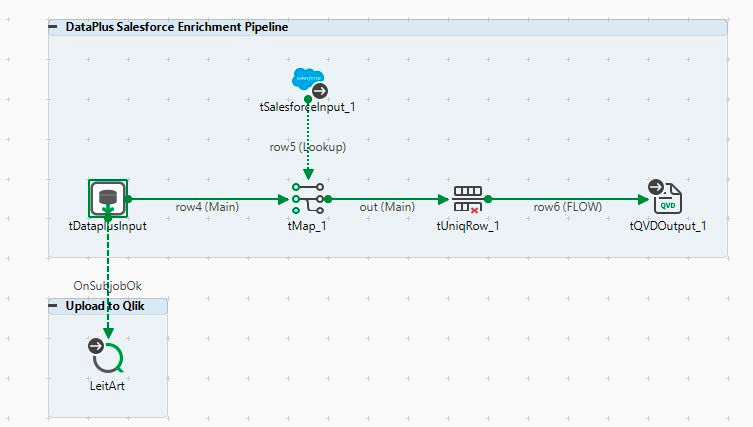
Example of a Talend job for data enrichment and QVD generation.
The process: The raw data collected by the specialist departments is queried via the tDataPlusInput component.
The refinement: Using a tMap component, we link this data stream live with a lookup on Salesforce to add customer attributes.
The goal: After removing duplicates (tUniqRow), the result is written directly to a highly optimized QVD file . This makes the data available to Qlik Sense for the next dashboard update in a flash.
Scenario 2: Data upload and rapid prototyping
The counterpart to this is writing directly to the data+ platform. Our second job demonstrates just how straightforward and streamlined this process is:
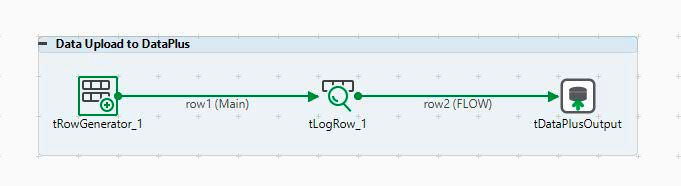
Minimalist Talend job for direct test upload of datasets via tDataPlusOutput.
The process: A tRowGenerator generates test data or reads in predefined structures.
The control: The data is output to the Talend console for direct validation via tLogRow.
The goal: tDataPlusOutput transfers the data records directly live into the data+ backend using bulk operations or UPSERT.
The advantage for developers:
New data models, API permissions, and performance scenarios can thus be validated within seconds, without having to rely on complex upstream systems.
Conclusion: data+ is becoming a universal data hub.
With the release of tDataPlusInput and tDataPlusOutput, the data+ Suite finally grows out of the "Qlik extension" category. It establishes itself as a central, bidirectional data hub within the company.
Business departments retain their familiar, intuitive input interface in Qlik, while IT and data engineering teams enjoy full control, stability, and flexibility in their central Talend pipelines. The result? Their data pipelines are cleaner, more maintainable, and significantly faster to develop.
Want to see the new components in action? Contact us for a free live demo and find out how you can accelerate your data processes!